Staffing
As at 31 March 2001, the Land Registry had an establishment of 570 posts, as compared to 593 posts a year ago. The reduction was due to the successful implementation of efficiency improvement projects and enhanced productivity programmes; it also reflects the efforts made by the department in support of the central initiative to contain the size of the Civil Service.It is the policy of the Land Registry to keep its manpower resources flexible by re-deploying staff to meet changing operational needs and supplementing permanent staff with non-civil service contract employees. In the past year, the number of non-civil service contract staff employed represented 4.9% to 6.3% of total strength, depending on fluctuations in business. Such employment enables the Registry to respond readily to business fluctuations while containing staff costs.
Land Registry Personnel (as at 31 March 2001)
| Directorate Officers | : | 5 |
| Legal Officers | : | 3 |
| Accounting Officers | : | 4 |
| Executive Officers | : | 4 |
| Land Registration Officers | : | 72 |
| Clerical Officers | : | 450 |
| Secretarial Officers | : | 13 |
| Others | : | 19 |
| Total | : | 570 |
Management Initiatives
To inculcate and sustain a client-based and performance-focused service culture that support the Land Registry's pledge for quality customer service, cost-effectiveness, commitment and teamwork, the department has vigorously pursued a number of management initiatives over the years.The Land Registry's vision, mission, objectives, service culture and pledges have been widely publicised and clearly explained to staff at all levels to ensure that they understand the organizational goals and the role they are expected to play in achieving them. Each functional division in the Registry has also developed its own mission statement directed towards achieving the department's objectives.
As staff are the Registry's key resources, the management has drawn up a Human Resource Management Plan each year in consultation with staff to help them meet the Registry's objectives. The Human Resource Management Plan was further updated and promulgated in June 2000.
The implementation of a four-level Performance Incentive Scheme commenced in January 1997. It is part and parcel of the human resource management initiative package aimed at reinforcing a performance-oriented service culture, motivating staff to meet the challenges under trading fund operations and improving the quality of services to customers.
Level One of the Scheme, based on achieving performance pledges, controlling the progress and expenditure of capital projects and meeting financial targets, was repeated in 2000.
Level Two of the Scheme, based on achieving or exceeding targets set for selected service areas, savings in staff costs and general operating expenses against budget and proposals on cost saving, improving efficiency or generating revenue, was repeated in 2000. A cross-divisional auditing for the performance result of this level was conducted in March 2000 to provide impartial assessments on performance and achieved targets of the selected service areas.
The Staff Handbook provides staff with a structured, handy and updated references to the Registry's vision, mission, objectives, core values and operational procedures. It also incorporates the Registry's history, conditions of service, basic house rules and regulations.
To enhance competencies, to maintain high standards of performance and to ensure consistency, various handbooks, guidelines and working manuals are issued and distributed to staff. The Staff Handbook on Land Search Services was reviewed and updated in February 2001 to provide front-line staff with a handy reference for answering enquiries on land search service and to better equip staff to communicate with customers and for handling complaints.
To improve accountability, division heads responsible for monitoring the financial performance of their respective budget centres are given authority to initiate appropriate action to achieve planned targets.
Training and Development
In recognition of human resource development as a critical success factor for the Land Registry, the Registry has adopted a strategic approach on staff training and development by linking training and development initiatives to departmental goals and objectives, reviewing training policies and plans regularly and promoting a continuous learning culture. The Land Registry executes training policies through its Training Unit which implements the annually endorsed departmental Training Plan.Further to the Training Needs Survey conducted in 1999, the Training Unit had carried out a "Re-prioritization of Training Needs Survey" in February 2000. The survey findings facilitated the Land Registry to systematically review its training priorities for the formulation of the Training Plan 2000/2001. The following charts show the distribution of training expenditure by training category and training activities by trainee days in 2000/2001.
Distribution of Training Expenditures - By Training Category
2000/2001 Total : HK$1,338,499
|
|
|
Distribution of Training Activities - By Trainee Days
2000/2001 Total : 2,585
|
|
|
Apart from the theme training, staff also attended courses on various topics including management, language and personal effectiveness skills provided by the Civil Service Training and Development Institute (CSTDI) and other external training consultants. In addition, the Training Unit organised a spectrum of in-house activities to equip staff with the necessary knowledge and skills to cope with the business needs of the department. The major activities were:
- In-house seminar/workshop/course:
- Job-related Elementary Putonghua Courses
- Workshops on "Writing Performance Appraisal Reports in Chinese"
- Workshop on "Essential Skills for Effective Managerial Presentation"
- Workshops on "EQ and AQ for Success"
- Workshops on "Communication Skills in the Workplace"
- Workshops on "Problem Solving and Decision Making"
- Computer Courses on "Database"
- Non-office Hours Programme on "English Writing Skills"
- Self-learning packages on "From Brain to Heart" and "The Political Administrative System of the Mainland (2nd Edition) Booklet"
- Talks on "Civil Service Integrity" by the Independent Commission Against Corruption
- Video sessions on "Basic Law"
For specific development training, a Chief Land Registration Officer received senior management development training through attending the "Leadership in the Public Sector Programme" at the CSTDI in October 2000. A Senior Land Registration Officer also attended the "Human Resource Management Program" at the National University of Singapore in November 2000.
A total of 79 Clerical Assistants attended a series of half-day seminars on interviewing techniques in March and April 2001 that were specially designed by the department's General Support Services Division to equip them with the necessary skills for attending the in-service appointment selection interviews.
To further develop a multi-skilled clerical workforce and to enhance staff's IT skills, the Land Registry has, for the third year, committed resources in computer skills training for all clerical grades staff. Database training was provided through commissioned IT training companies. Training on Internet usage was provided at the Registry's own Learning Resource Centre through a self-learning programme on "Fundamental Knowledge on Internet". Owing to the overwhelming response, the enrolments for the self-learning programme on "Fundamental Knowledge on Internet" will extend to the year 2001/2002.
A total of 461 staff attended training on "Stress Management" and "Customer Service" through computer-based self-learning programmes in the Land Registry's Learning Resource Centre. During the year, training resources including videos, CD-ROMs, books and periodicals were replenished regularly. To facilitate and promote wider usage of the training resources, the Learning Resource Centre was opened during lunchtime on Mondays and Wednesdays. As a further step to promote self-learning among staff, a computer with the necessary software for self-learning purpose had been installed in each of the nine outstation offices. With dedicated training equipment in place, the Training Unit is able to circulate training resources to the outstation offices which make learning more convenient.
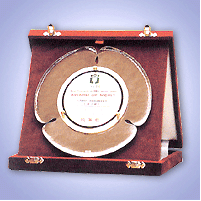
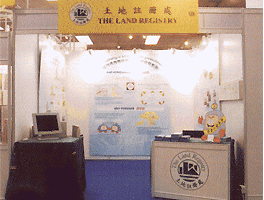
The year 2000/2001 was a memorable and fruitful year for staff development and training in the Land Registry. In November 2000, the Registry participated in the Civil Service Training and Development Institute Best Practices in Human Resource Development Award 2000 and won an Award of Merit. The Land Registry was also invited to participate as one of the nine government exhibitors in the Symposium cum Exhibition on Continuous Learning & Development in the Civil Service which kicked off the Three-year Training and Development Programme for Civil Servants 2001/2002 - 2003/2004. The aforesaid events provided the Registry with valuable reach-out and experience-sharing opportunities in the training and development field.
The year 2000/2001 was a memorable and fruitful year for staff development and training in the Land Registry. In November 2000, the Registry participated in the Civil Service Training and Development Institute Best Practices in Human Resource Development Award 2000 and won an Award of Merit. The Land Registry was also invited to participate as one of the nine government exhibitors in the Symposium cum Exhibition on Continuous Learning & Development in the Civil Service which kicked off the Three-year Training and Development Programme for Civil Servants 2001/2002 - 2003/2004. The aforesaid events provided the Registry with valuable reach-out and experience-sharing opportunities in the training and development field.
Staff Relations
Effective communication between management and staff, and among staff themselves at all levels, is important to the success of the department in achieving its goals and objectives.
The Land Registrar meets all senior management staff weekly; the Registry Manager meets all senior line managers monthly; Division Heads hold regular meetings with their staff. The Land Registrar and Registry Manager maintain close liaison with the Land Registration Officers' Branch of the Hong Kong Chinese Civil Servants' Association. They also pay regular visits to staff in the New Territories Land Registries and outstation offices. ChangeNEWs is issued at regular intervals to keep staff informed of the progress and development of projects, and related operational matters and HRM issues. Any suggestions made by staff through the Staff Suggestion Box Scheme (introduced in 1999) will be brought to the Land Registrar's personal attention.
Two Staff Relations Officers have been appointed to look after the interests of officers in the Land Registration Officer and General Grades. They pay goodwill visits to staff at their workplaces regularly.
The Departmental Consultative Committee, consisting of 14 representatives of various staff groups, meets quarterly to promote better understanding and co-operation between staff and management.
The Land Registrar meets all senior management staff weekly; the Registry Manager meets all senior line managers monthly; Division Heads hold regular meetings with their staff. The Land Registrar and Registry Manager maintain close liaison with the Land Registration Officers' Branch of the Hong Kong Chinese Civil Servants' Association. They also pay regular visits to staff in the New Territories Land Registries and outstation offices. ChangeNEWs is issued at regular intervals to keep staff informed of the progress and development of projects, and related operational matters and HRM issues. Any suggestions made by staff through the Staff Suggestion Box Scheme (introduced in 1999) will be brought to the Land Registrar's personal attention.
Two Staff Relations Officers have been appointed to look after the interests of officers in the Land Registration Officer and General Grades. They pay goodwill visits to staff at their workplaces regularly.
The Departmental Consultative Committee, consisting of 14 representatives of various staff groups, meets quarterly to promote better understanding and co-operation between staff and management.
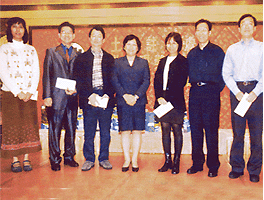
The Departmental Staff Suggestions Committee continues to receive suggestions from staff. A total of 6 staff suggestions were received during the year and various awards, including cash prizes, were granted for the constructive or useful suggestions. Staff have been invited to make suggestions on such issues as opening up new business opportunities, promoting team spirit, improving customer service, saving resources and promoting green management etc.. The 'Best Staff of the Year Award' was organised again in December 2000 and all staff were invited to vote for the 'Best Staff'. This year recorded a 10% increase in staff participation. The Land Registry's Long Service Appreciation Award Scheme that was first introduced in 1999 in recognition of officers with long and meritorious service was held again in the year. So far, 26 staff members with 25 or more years of service have been awarded. The awards, certificates and promotion letters were presented to recipients at social functions organised from time to time.
The Staff Magazine, a departmental publication produced by staff themselves, was issued quarterly under the guidance of an Editorial Board comprising officers from different grades and ranks. The Magazine has proved to be a popular publication among staff that has helped promote team spirit and a sense of 'corporate identity'.
The Staff Magazine, a departmental publication produced by staff themselves, was issued quarterly under the guidance of an Editorial Board comprising officers from different grades and ranks. The Magazine has proved to be a popular publication among staff that has helped promote team spirit and a sense of 'corporate identity'.
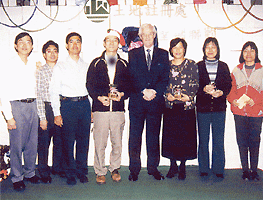
The Land Registry Staff Recreation Club had organised a variety of recreational activities in the year, including the Performance Incentive Scheme cum 7th Annual Dinner held in November 2000, a Christmas Party, two outings, various interest classes and sports activities. The Annual Dinner is a major event of the Land Registry which was well attended by over 440 staff. The Club had also formed sports teams to participate in various sporting events and competitions organised by the Lands and Works group of departments.
In supporting charities, staff of the Land Registry have actively participated in various charitable events such as the Dress Casual Day, Bring Your Family to Work Day, etc., organised by the Community Chest and other voluntary agencies.
In supporting charities, staff of the Land Registry have actively participated in various charitable events such as the Dress Casual Day, Bring Your Family to Work Day, etc., organised by the Community Chest and other voluntary agencies.
Safe Workplace
As a good employer, the Land Registry continues to provide a safe and healthy working environment for its staff.
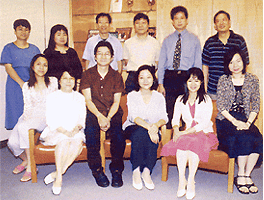
The Safety Management Committee, chaired by the Registry Manager, is responsible for monitoring and reviewing occupational safety and health measures undertaken in the Registry. A policy statement on occupational safety and health was issued in October 1997 to promote staff awareness. A safety survey to identify the department's current state of occupational safety and health is conducted annually and remedial measures will be taken to rectify any deficiency identified.
The Safety Management Committee, chaired by the Registry Manager, is responsible for monitoring and reviewing occupational safety and health measures undertaken in the Registry. A policy statement on occupational safety and health was issued in October 1997 to promote staff awareness. A safety survey to identify the department's current state of occupational safety and health is conducted annually and remedial measures will be taken to rectify any deficiency identified.

During the year, members of the Safety Management Committee were nominated to attend a basic safety and health management course to better equip them to discharge their duties. In addition, staff were also nominated to attend a basic first aid course organised by the Auxiliary Medical Service.
Green Management and Environmental Improvement
Controlling Officer's Environmental Report (COER) 2000Introduction
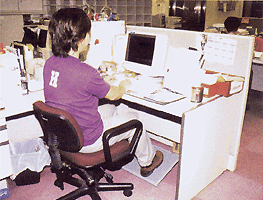
This is the Land Registry's third Environmental Report. We aim to cover in this brief report the environmental impacts arising from our operations, our environmental management system, our green policy and objective, the measures that we have taken to address our environmental concerns, how we have performed and what we intend to do to improve our performance.Environmental Impacts of our Operations
Our main services include the registration of land documents, search of land registers and records, supply of copies of land records, certification of such records, among others. Our operations have given rise to the consumption of great volume of papers on a daily basis. We managed to reduce the consumption through introduction of the Direct Access Services (DAS) in 1994 under which our customers could obtain copies of land records through their own computer terminals. In subsequent years, we managed to reduce paper consumption further with the production of compact diskettes carrying up-to-date information on property transactions, mortgage transactions and lot numbers of urban and NT properties for sale to our customers.Our Environmental Management System
We direct our efforts on environmental issues at many levels. Since 1994, we have appointed our Registry Manager as the Green Manager to oversee our environmental policy and performance. We have also established a Green Housekeeping Working Group comprising the Departmental Secretary and divisional representatives to coordinate the implementation of green initiatives and monitor progress. The Working Group meets about four times annually. In addition, we have appointed a Green Executive for each office to assist in implementing the green measures on site.Our Environmental Objective and Green Management Policy
We aim to carry out our operations in an environmentally responsible manner, applying the principles of "Reduce, Reuse, Recycle and Replace" and seeking continual improvement in the efficient use of resources and energy. To achieve this objective, we adopt the following policy:- Minimization of Consumption and Waste - We encourage minimization in the consumption of paper, the reuse of used materials, the recycling of waste and the replacement of non-environmentally friendly products as far as possible.
- Training and Communication - We ensure that our staff are aware of their environmental responsibilities through training and communication. We also encourage their participation in environmental activities, including attendance at relevant workshops and seminars.
- Improvement - We seek continual improvement in environmental performance through regular review and assessment, and by implementing new green measures and practices.
Our Green Housekeeping Measures
We have introduced the following measures to address our environmental concerns and meet the above objective:- Reduce paper consumption - We use both sides of paper and encourage double-sided copying. We encourage using GOA and departmental LAN for internal communication to minimize paper circulation. We have also established an information management system to maintain management reports, statistics, circulars and notices in electronic form.
- Reduce energy consumption - We encourage our staff to use staircases instead of lifts to commute between different floors of our offices, to switch off lights and electrical equipment when not in use, to use energy saving devices wherever possible, and to reduce the consumption of water as far as possible.
- Reuse and Recycle - We reuse papers, envelopes, paper-clips, ball-pen holders and we collect such items for reuse. We place green boxes at strategic locations in our offices for the collection of waste paper for recycling. We also place green boxes in our public search halls to raise the environmental awareness of the general public.
- Environmental Audit - We carry out environmental audit for all our offices at regular intervals to review our operations and verify compliance with our environmental policy and guidelines. The audit findings and improvement proposals are provided to divisional managers and the Green Housekeeping Working Group for development of action plans; such plans are reviewed and approved by the senior management. In the Year 2000, we have performed environmental audit for four offices. As at the end of March 2001, we have carried out audit for seven offices. Our target is to perform audit for all our offices in order to seek continual and sustain improvement.
- Green office environment - We encourage our staff to decorate their offices with green plants. We seek to improve the air quality of our offices through working with the Electrical and Mechanical Services Department and cleaning air ducts.

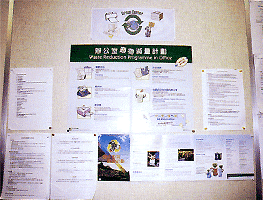
- Publicity - We display our green management policy, green housekeeping rules and good environmental practices on the notice-boards of our offices to promote awareness among staff and the people visiting our offices. We also encourage our staff to participate in green events, e.g. "the Community Chest Green Day".